
A team building idea people actually turn up for is one with nothing to rank: no scoreboard, no audience and nobody who can come last. For your day, that means pairing a working session with a free afternoon in which people split up by appetite rather than ability, so nobody is assessed and nobody needs an excuse.
The honest measure of a team day is not how much anyone enjoyed it. It is how many of them turned up. Count the apologies that land in the two days before — the dentist, the childcare, the deadline that suddenly cannot move — and you have a fairly precise reading of what the team thought of the format the moment it was announced.
Those apologies are not randomly distributed. The same people send them, they send them for the same kinds of day, and the reason is structural rather than moody: almost every format in circulation is a competition with the scoring left implicit. Somebody comes last. They generally work out who it will be before the calendar invitation has finished loading.
What follows is not a list of activities. It is one question to put to any activity you are considering — what does this measure? — and then what happens to a day when the answer is nothing at all.
What is team building, and what do the ideas quietly measure?
It is time a company spends together, away from the work itself, so that its people work better together afterwards. Every format below is genuinely good fun for part of a team. The problem is that each one has an axis, and the axis decides in advance who spends the afternoon at the front of the room and who spends it hoping not to be picked.
- Escape rooms measure lateral thinking, out loud, at speed — The person credited with solving it is the person who was talking while solving it. Anyone who thinks quietly ends up watching, and an hour is long enough for everyone in the room to notice which is which.
- Karting, sports days and assault courses measure the body — Age, weight, a knee that has never been right since. They also ask people to be seen at their least composed by whoever writes their appraisal, which is a bigger ask than the organiser usually realises.
- Quizzes measure a particular kind of schooling — General knowledge is largely a record of what you were exposed to before you were twenty. Set it against a team of mixed backgrounds and nationalities and you have ranked them by upbringing, then called it a bit of fun.
- Cooking, improv and anything fed back to the room measures performance — There is an audience, and the audience contains your boss. The confident third find this energising. Everybody else is sitting an exam they were not told about and cannot revise for.
- Anything built around a bar measures tolerance and free evenings — It quietly excludes people who do not drink, people who are driving, and people who have to be somewhere at six. That group gets larger every year, and it is not the group a company can afford to lose from the invitation list.
Before booking anything, work out who on your team would come last at it. If a name arrives instantly, it arrived instantly for them too — and it comes back to you as a dentist appointment on the Tuesday.
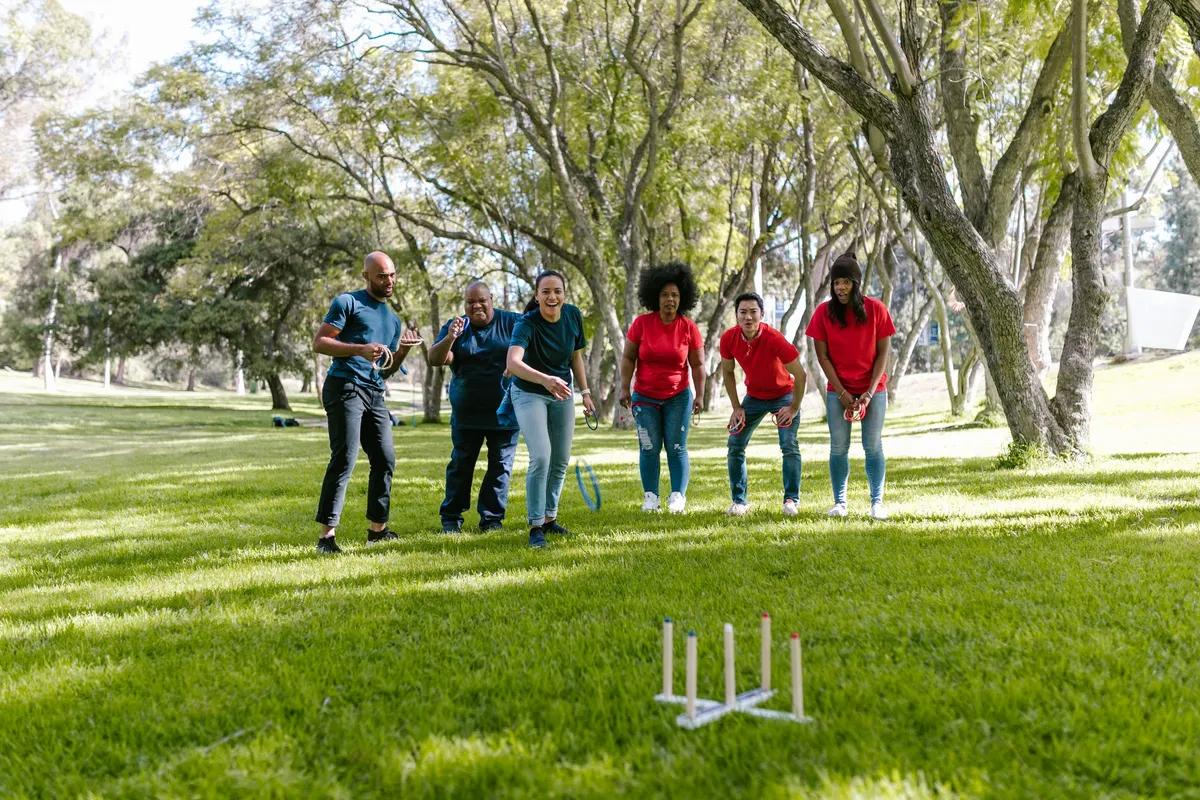
The apology is a status decision, not a diary clash
This is the part organisers tend to take personally, and should not. Nobody is opting out of the company. They are declining to be publicly worse at something than a colleague they manage, or than a graduate who joined in March. That is a rational thing to protect, and no amount of enthusiasm in the announcement email overrides it.
The cost is worse than a headcount, because the people most likely to send the apology are the people the day was for. New joiners with nothing to fall back on. Remote workers who would have to travel furthest to be embarrassed. The quiet department nobody else has spoken to since the reorganisation. A format that ranks people filters out precisely the attendance that would have justified the budget.
What a day with nothing to rank looks like here
The room does the work before lunch — the Lakeside Hall is one open room with a stage, a screen and the day package's AV, so the plenary runs without anybody leaving the building, and if the agenda needs separate breakouts you say so on the quote and we tell you what is possible. That half is a working session and it is scored like any working session: not at all.
Then the afternoon is in the park around the venue, with park entry in the Bronze and Silver day packages for a corporate away day on days the park is open, and the mechanism is worth being precise about, because it is not simply that a theme park is enjoyable. It is that the group dissolves and re-forms by appetite instead of by ability. The people who want the tallest ride in the park go and find it. The people who want the gentle coaster go and find that. Both groups come back with the same length of story, and neither has been assessed. Somebody screaming is not somebody losing.
The other property is the one nobody puts in a brochure: a person can go and sit down at any point without it reading as a withdrawal from the activity. There is no activity to withdraw from. Half an hour on the deck is not the same social act as putting down a paddle in front of eleven colleagues. It is the day our team days at the park are built around.
| Option | What it is | What it needs |
|---|---|---|
| Park entry | In the Bronze and Silver day packages: a normal afternoon in the park with your group inside it | The park open on your date |
| Fastrack | A queue-jump on top of park entry, in five levels | Park entry, so a day package, and the park open |
| Exclusive ride time | One train on one ride kept for your group, by the hour | The ride running; we confirm it for your date |
There is a floor, too. Under about 40, honestly, not this: a whole venue you cannot fill makes a worse day than a meeting room near your office, and we would rather say so. The Silver day package has a 100-guest minimum.
Where this format still sorts people, and what we do about it
An argument this confident owes you its own exception, so here it is. A park does have one axis, and it is a real one.
- Height, health and mobility restrictions apply to some rides — They are not negotiable and they are not something a venue can absorb. A day designed entirely around riding will leave somebody out, and it is better to know that now than at the gate.
- A parallel track is planned in advance rather than arranged on the day — The garden, the deck, something quieter, with lunch running through the middle of it. The difference between a plan and an improvisation is whether anybody ends up holding coats.
- Step-free routes, a quiet room, BSL and carer places — Told to your planner at booking, confirmed in writing and drawn into the plan rather than solved in front of guests.
- The deck, right outside the room — It runs 31 m along the garden side with doors from the Hall, so somewhere to sit out is a step away rather than a walk. Somewhere to be that is not a car park is what makes sitting out an option rather than an exile.
Also true, and worth saying early: the park is not open every day of the year, and the park half of this day only works on a day it is open. We confirm that for your date before it goes on the quote. If your date is fixed and the park is closed that day, the honest answer is a different date rather than a different quote.

When a facilitated exercise is genuinely the right answer
We can add one: a scavenger hunt, or a chocolate rollercoaster-making session, quoted beside everything else on the same quote. Where the scavenger hunt runs is confirmed for your date. The argument above is about the default, not about the exception, and there are three real exceptions.
- The team has genuinely never met — Twelve people who joined in the same quarter share no reference points at all. A structured hour manufactures some faster than free time does, because free time sends everyone back to the two people they already know.
- There is a specific skill being taught — Giving feedback, negotiating, running an incident. That is training, it works, and filing it under team building is most of the reason the whole category has the reputation it has.
- You have run one that landed — Then run it again. Somebody who knows their own team beats a general argument about teams, including this one.
How to announce it so people believe you
The format is only half the attendance problem. The other half is the announcement, because everybody opens an email with those two words in the subject line looking for the catch, and finds one whether or not you put it there.
- Say there is no exercise — In those words. People assume one is hiding behind the enjoyable part, because in their experience it usually was.
- Say nothing is being presented back — The dread is rarely the activity itself. It is the twenty minutes at the end where each group stands up and feeds back to the room.
- Say any of it can be sat out, and mean it — One line giving explicit permission to skip a part is the thing that gets people to come to the whole. Withdrawing the permission on the day costs you the next three events.
- Say precisely when it ends — A share of every apology is logistics wearing a disguise. A stated finish time, car parking in the package and a coach back to the office removes most of it.
A team day that half the team dodged has not failed on the day. It failed in the subject line, three weeks earlier, when people read the format and worked out where they would come in it.
Questions people ask
Does team building actually work?
The days that work do it accidentally. What changes how colleagues speak to each other is unstructured time in mixed company, not a structured exercise about unstructured time — so the formats that succeed are usually the ones nobody sold as an exercise at all. Anything that makes people perform in front of the room tends to confirm the hierarchy it was booked to loosen.
What works for a group with mixed ages and fitness?
Ones with no physical scoring anywhere in them. Karting, sports days and assault courses all rank a mixed group by body, and the people ranked lowest are already the least likely to come. Look for a format where two colleagues can spend three hours doing entirely different things and both come back with a story of the same length.
How do we stop people dropping out at the last minute?
Remove the ranking, then remove the logistics. Most late apologies are either a reluctance to be publicly worse at something than a colleague, or a genuine problem getting home afterwards. State in the invitation that nothing is being presented back and give a precise finish time; parking in the package and a coach handle the rest.
How many people do you need for a day like this?
The Silver day package is for 100 guests or more. Under about thirty, a meeting room near your office will serve you better, and we would rather say so than take the booking. At any size, exclusive ride time can be added by the hour, on days the park is open; we confirm the time for your date.
Can we still run a facilitated session if we want one?
Yes, and it is built around your group rather than pulled off a shelf. The honest uses for it are a team that has genuinely never met and a specific skill being taught — feedback, negotiation, an incident drill. Booked as the default for people who have worked together for years, it is the thing they pretend to be ill for.
Give your team a day somewhere different
Tell us the numbers, the date and who on the team you are worried about losing — your planner comes back within one working day with a shape and an itemised quote.