
If you have a venue site visit booked, spend it on what only shows in person: the walk from the car park, the joins between rooms and each room at the hour you use it. The building is the one thing on your shortlist that you cannot check from a desk. Everything else is a document: the quote, the capacities, the licensed hours, the list of what hire includes. A document is easier to read at your own table than standing in a room while somebody talks over the top of it, and yet the document is what most visits get spent on.
So the useful way to think about a visit is not an inspection but a rehearsal. You walk your own running order through the building, in sequence, at roughly the hour each part of it will happen. Do that and the problems introduce themselves. Stand in the middle of an empty room nodding, and you go home with a feeling instead of an answer.
Walk it in the order of your own day
Write the day down as a list of moves before you go. Guests park, guests arrive, drinks, sit down, speeches, the room turns around, dancing, taxis. Then walk those moves in that order, at the pace of the slowest person on your guest list. Almost everything that goes wrong on an event day is a move rather than a room.
- Start in the car park, not at the front door — It is where your guests start, and the walk in from the furthest bay in the rain is part of your event whether you plan it or not. Ask how many spaces there are, what happens when they fill, and what it costs. Car parking comes with our Bronze and Silver packages, and it is worth asking every venue the same question.
- Walk every join at guest pace — Not at the pace of the person showing you round. Here the Terrace is straight through the Hall's doors and the garden is down its steps; anything further, time it. Numbers like that are the difference between a drinks reception and a hike, and they are the first thing a floor plan flattens.
- Stand in the place where the room turns around — Between the meal and the dancing, everybody you have invited has to be somewhere for half an hour. Ask to be taken to that somewhere and look at whether it is under cover, whether there is a bar in it, and how far it is from where they were sitting.
- Finish where the taxis pull in — The last twenty minutes of any event happen outside in the dark. It is the part of the building nobody views and every guest remembers.
Anything a venue could put in an email, get in an email. The visit is for the three things that do not survive a PDF: the walk, the noise and the light.
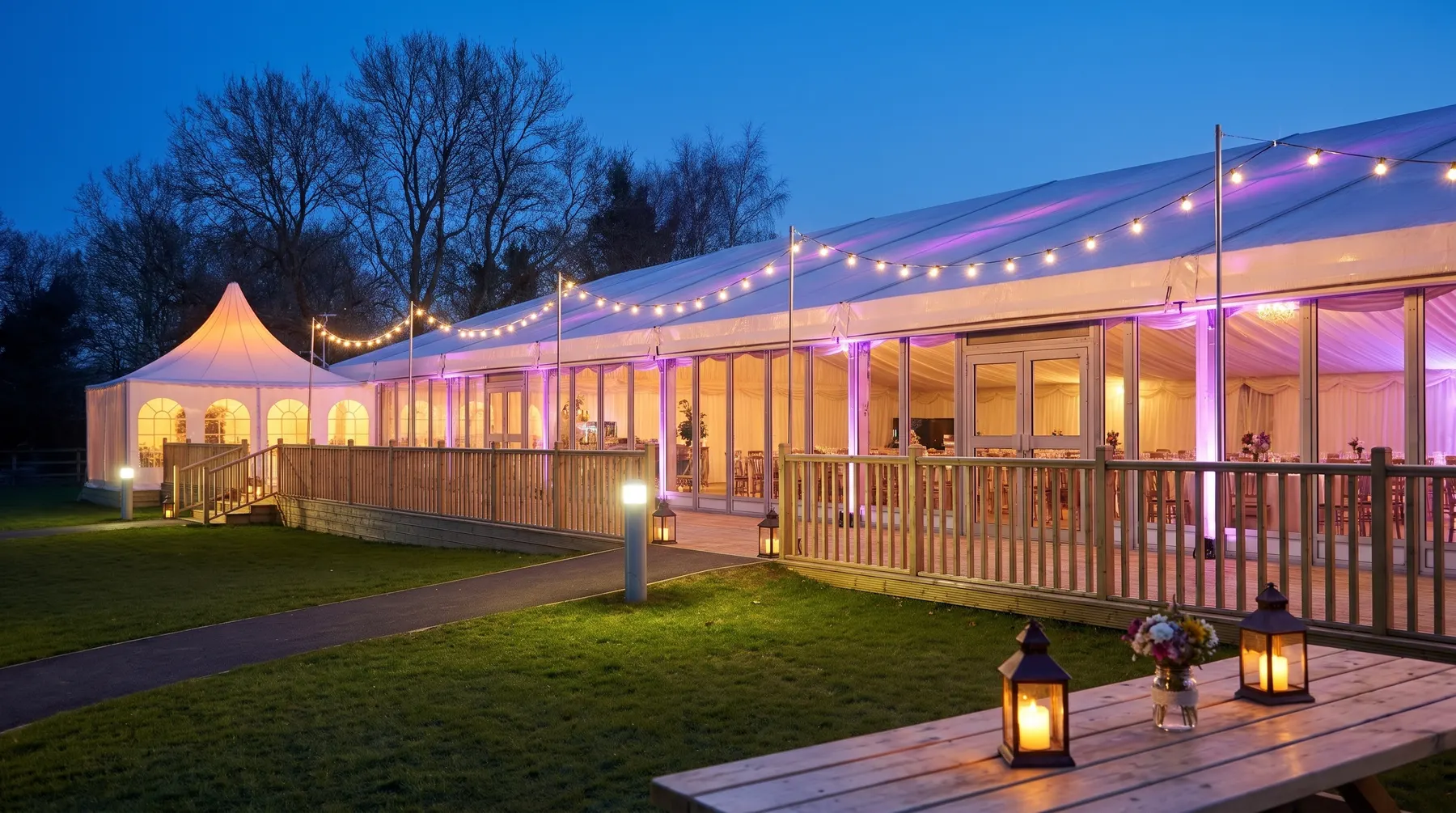
What to settle before the venue site visit
Every figure below is knowable in advance, and a venue that will not put them in writing before you travel has told you something useful already. This is what we can tell you about the Lakeside Hall today, offered less as a sales pitch than as a worked example of what the answer should look like; the row we cannot fill yet says so.
| Ask for | Ours |
|---|---|
| Floor | 30 m × 25 m, one open room |
| Stage and screen | A removable stage, 24 ft × 12 ft, with a 2.96 m × 2.2 m screen on the same wall |
| Dance floor | Removable, 4.5 m × 3.6 m |
| Blackout | Total: the Hall has no windows |
| Outside | A 31 m × 4.6 m deck through the Hall's doors, with steps down to a private garden |
| Kitchen, toilets, cloakroom | A kitchen with its own outside door, accessible toilets and a private cloakroom |
| Height, load-in, rigging, power, licensed hours | Confirmed for your event, set out in your quote |
Two things decide more events than anything printed in a brochure, and they are the two to chase in writing. Clear working height is the honest figure under the rig rather than the flattering one at the ridge, and anybody hanging anything overhead needs it. Licensed hours are never one number either: the music stops, the bar closes and the taxis arrive at three different times, so a venue that quotes you only the last of the three has quoted you the taxi.
The five things only a visit can show you
These are what the time is for. None of them can be written down honestly, and that is not the venue being evasive — they are properties of a building and of a body moving through it.
- The room at your number, not at its ceiling — A hall built for eight hundred standing is genuinely hard to picture with a hundred and twenty people in it, and the usual outcome is a room booked too big. Ask to see it laid out at your headcount, or for photographs of an event at your number rather than at their largest.
- The light at the hour you have booked — Showroom lighting flatters every room ever built. The Hall has no windows, so what you see is entirely what the rig is doing, and the fair request is to see it set at the level it would run at nine in the evening. Outside, the deck and the garden are a very different space at three in the afternoon from at nine in the evening.
- What you can hear, and from where — Go and stand in the room next door while something is happening in the main one. The Hall is one open room, so the question here is what else is happening on the site and in the park on your date, and where. Ask that of every venue.
- The ground, and what it does when it rains — Grass that is fine in June is not fine in October. Ask what the garden is like underfoot after rain, and what happens to the outdoor part of the day if it is not usable. It is something you either feel standing on it or take on trust.
- Where the queue forms — Every event has one pinch point and it is nearly always the bar, the cloakroom or a single door. Here, look at where the bar goes in relation to the deck doors, because that is where a hundred people will want a drink in the same ten minutes.
A room you cannot picture full is a room you will book too big. It is the most expensive mistake available on a site visit and it is made by nodding politely in an empty hall.
One thing to look at in each space
Every space has a single fact that a photograph will not carry, and it is usually the fact that decides whether the space works for you. Ours, in the order you would walk them; each has its own page among our event spaces in Chertsey.
| Space | Only visible in person | Ask while you are standing in it |
|---|---|---|
| The Lakeside Hall | Solid panels, no windows | Show me the rig at evening level |
| The deck | 31 m long, straight through the Hall's doors | Where does the drinks queue actually stand? |
| The garden | Down the deck steps; size on request | Who calls the weather, and at what time? |
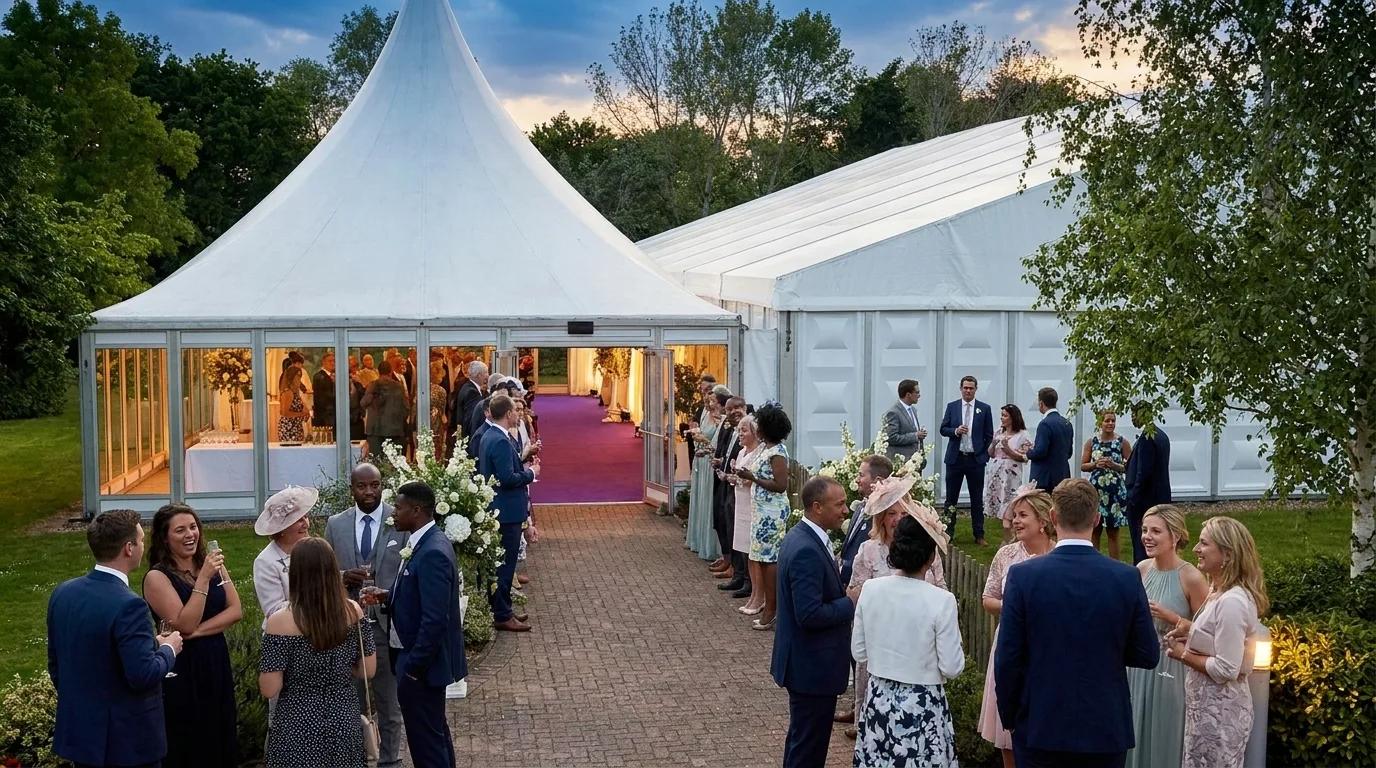
| The Garden Marquee | Two doors, beside the deck, opening into the Hall; size on request | How big is it, and how dark does it get at two in the afternoon? |
The Marquee row is the one to settle in person. Its size is on request, so ask to stand in it, and ask how dark it gets: a roof that lets light in is lovely over a long lunch and a problem in front of a screen. Nobody writes that in a brochure, and you can establish it in four seconds by looking up.
Go at the hour your event actually happens
A Tuesday-morning show round of a room you are booking for a Saturday night is a tour of a different building. The light changes, the noise changes, the temperature changes, and so does how busy the rest of the site is around you.
- An evening party — Ask to see the room dark, with the lighting at the level you will really run. Ten minutes of that is worth an hour in the middle of the day, and a venue that cannot switch its rig over for you is telling you how much control you will have on the night.
- Anything outdoors — Visit inside the season and you learn something; visit outside it and you are being asked to imagine. Ask which months the deck and garden are used, because a walk round a lawn in February is a leap of faith in both directions.
- A conference or a training day — Come on a weekday when the building is working. You want to see a load-in happening, a queue at the coffee, a room being turned around between sessions — not a silent hall with the lights up.
- A wedding — See it dressed if you possibly can. Ask whether the room is being set for an event before your date that you could see, because an empty room at this scale tells a couple almost nothing they need.
If you are planning a conference or a fiftieth, a weekday show round is the honest option and you will see the same building undressed. A rehearsal or a second walk-through nearer the day is on our own list: ask for it when you enquire and your planner confirms it in writing. It is the answer worth pushing for anywhere else.
The questions we would rather you asked us
The end of a visit is where you find out whether the person walking you round will say something that costs them money. Here are four we answer badly for ourselves, on purpose, because you would find all four out later anyway and later is the expensive time to find them.
- Are you licensed for civil ceremonies? — Ceremonies here are celebrant-led, with the legal formalities at a register office, so plan the legal fifteen minutes there and the ceremony or a blessing here. Ask it early of everyone on your list, because it is the one answer that cannot be worked around on the day.
- If it rains, which room do we finish in, and who makes that call? — Here the answer is the Lakeside Hall: the deck and garden sit right outside its doors, so the fallback is the room you have already booked, and we agree the time of the call with you. Ask it space by space rather than once, because the answer for a drinks terrace is rarely the answer for a ceremony on grass. A plan that is not a named room, a named decision-maker and a time is not a plan.
- What is genuinely wrong with this room for us? — The Hall has no daylight in it at any hour of the day. The deck is through its doors, which is the answer for a break, but it is a real thing to know before you commit a conference to it. A venue with nothing at all to say here is selling rather than advising.
- Which named person is on site at setup and at carriages? — A name, not a department, and the two ends of the day rather than the middle of it. Plenty of venues staff a dinner beautifully and leave the load-in and the last hour to whoever happens to be on shift.
Take three things home with you. A photograph of the wall you will have to dress, because that is what your styling budget is really for. A rough count of paces between the two ends of your day. And the written specification you were sent before you came, now marked up in your own handwriting. The feeling fades inside a day; those three survive to the next venue on the list, which is the only place a comparison can honestly be made.
Questions people ask
What should you actually look for on a venue site visit?
Three things a document cannot carry: the walk between the parts of your day, the room at your headcount rather than at its capacity, and the lighting at the hour you have booked. Everything else — capacities, hire fees, licensed hours, what is included — should already be in your inbox before you get in the car.
How long does a site visit need to be?
Long enough to walk your entire running order in sequence, which is usually about an hour and is longer than most venues offer. If you let the venue lead, you get the rooms in the order that shows best. Walking it yourself, car park first and taxi rank last, is what surfaces the problems.
What time of day should I visit a venue?
As close as you can get to the hour your event runs. An evening party seen at eleven in the morning is a different building: house lights up, rig off, and nothing in front of you is what your guests will see. Outdoor space seen out of season is guesswork, so ask which months the outdoor space is used and see it in one of them.
Is it better to go to an open day or a private show round?
An open day, if your event is a wedding and one falls in time, because a dressed room at your own headcount answers a question an empty room cannot. For a conference or a birthday, a weekday show round is more useful, because you see the building working.
What should a venue send me before I visit?
A written specification, and the list is short: clear working height, load-in door size, rigging limits, power, blackout, licensed hours split into music, bar and carriages, and the kitchen. If a venue will not commit those to an email before you travel, that reluctance is itself the most useful thing you learned that week.
See if Thrillwater is the right room for your date
Tell us the date, the numbers and roughly how the day runs. Your planner comes back within one working day with everything itemised, and you can walk the building afterwards knowing what it costs.