
Dry hire means hiring a room and its fixed kit on their own, without a package, so food, drink and anything beyond the room are agreed separately. Here that is the Lakeside Hall with tables and chairs set theatre or cabaret, a projector, house lights, a mic and a sound system, and Wi-Fi, while catering, bar hire and the dance floor are quoted separately. That is the meaning; the contents vary. Ask three venues what dry hire includes and you will get three different lists, all of them called dry hire. At one it is a key and a bare room. At another it is everything short of the food. The phrase describes how a venue bills rather than what it hands over, which is why two dry hire quotes are close to impossible to compare until both lists are written down.
So here is ours, written down, including the half that is not in it. The second half is the useful one: staffing, cleaning and the licence are the three jobs people assume arrive with the room, and they are the ones to settle in writing.
Dry hire meaning: what the fee actually buys
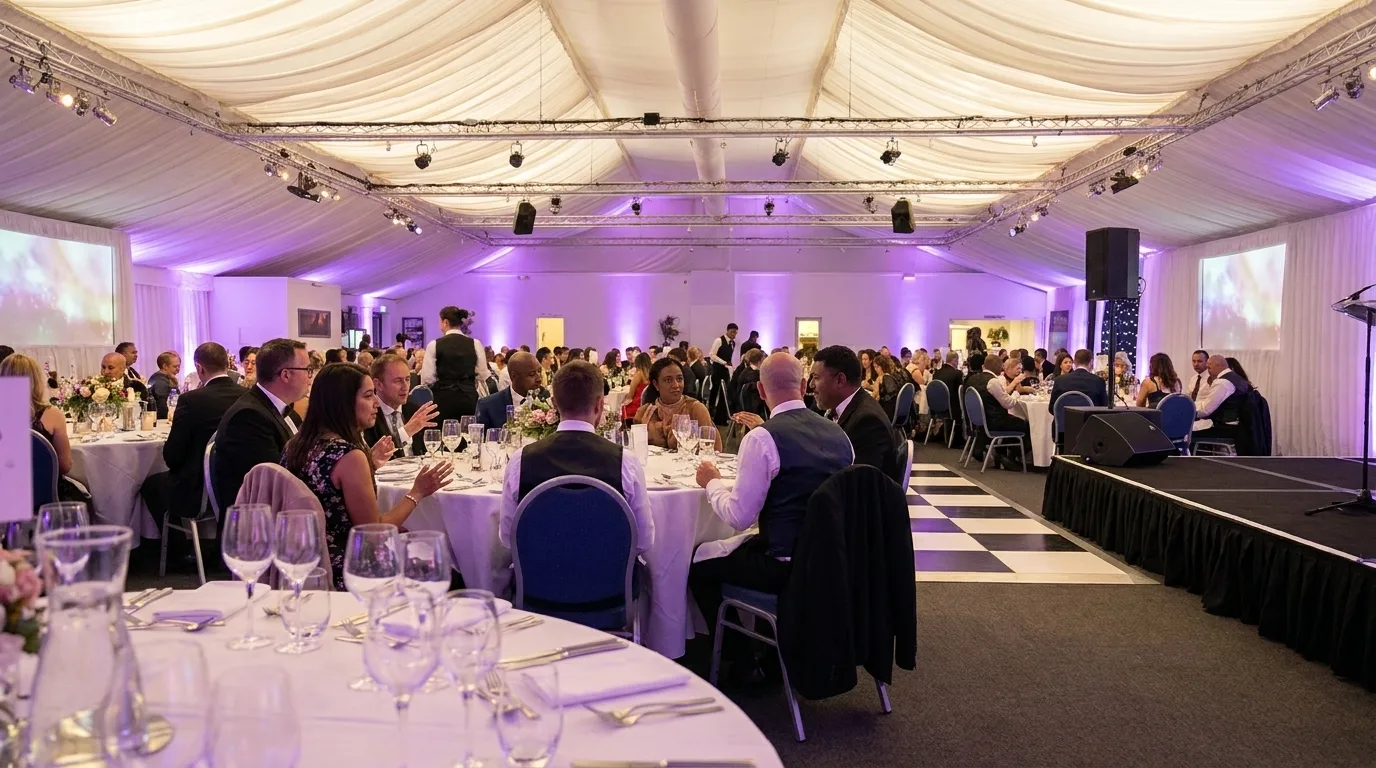
Here dry hire means the Lakeside Hall on its own, without a package: one open room on a 30 m by 25 m floor, tables and chairs set theatre or cabaret, a projector, house lights, a mic and a sound system, and super-fast Wi-Fi. It is booked by the hour rather than per person, and the hours you need are set out in your quote.
| The job | In the hire? |
|---|---|
| The Lakeside Hall, booked by the hour | Yes |
| Tables and chairs, theatre or cabaret | Yes |
| Projector, house lights, mic and sound system | Yes |
| Super-fast Wi-Fi | Yes |
| Food and drink | No: catering, a food upgrade or bar hire are quoted separately |
| The dance floor | No: an add-on |
| An extra hour for set-up | An add-on |
| Car parking | Confirmed on your quote |
| Cleaning and clear-down | Confirmed on your quote |
| Staff for your event, such as door staff or a cloakroom attendant | Confirmed on your quote |
Ask any venue what its hire figure includes in those words, and whether anything you will certainly need sits outside it. The answer moves a total more than the headline fee does.
Dry hire does not automatically mean bring your own bar, and that misunderstanding is most of the reason this page exists. Who supplies the drink, and whether your own caterer can work in the kitchen, are set out in your quote rather than assumed here. Bar hire is one of our add-ons.
Staffing: running the building is not running your event
Whoever is on site on your date to look after the building is not the same as a person standing beside you at seven o'clock deciding whether the speeches start now. Ask every venue which of those two you are getting.
- A duty manager is not an event manager — One runs the building on your date and answers to the building; the other runs your evening. The distinction is invisible in a quote and extremely visible at half past six. Ask which one your hire includes.
- Kit and a technician are two different lines — Dry hire includes the kit. Somebody at the desk for your whole event is a separate question. If your evening has a band, an autocue or a montage that has to play at the right second, you want that person.
- Door staff are priced by the guard, not by the event — At a young party, ask how many are needed and who provides them before the guest list is final, not after.
- Cloakroom, stewards and a registration desk are each their own line — Individually small, and collectively the three lines easiest to miss from the cheaper-looking of two quotes. A staffed cloakroom in particular is assumed by everyone.
- Your caterer's service staff belong to your caterer — Ask whether their price is food only. It is a question about their invoice rather than ours, and it is the widest gap between a dry hire budget and a dry hire bill.
Cleaning, clear-down and the bit that gets recharged
Cleaning is the line nobody raises at enquiry and everybody thinks about at midnight. Whether a cleaning charge sits on top of the hire for your event is confirmed on your quote rather than assumed on a web page, and it is worth asking every venue in exactly those words. What is certainly outside it is everything that arrived with somebody you appointed directly.
- What your suppliers brought in leaves with them — A stage, props, flight cases, the boxes the florals came in. Agree the out time with each supplier when you book them rather than on the night, when three vans are competing for one door.
- Ask how damage is handled — Every venue has a policy; the version worth having is the one that shows you what it is charging for, with photographs. Your quote sets ours out.
- Property left behind needs an owner — Gifts, coats, a hired jacket, the laptop from the presentation. Nominate somebody sober to do a sweep before the room empties; property left on site at one in the morning is nobody's job unless you make it somebody's.
The licence, and what it decides
This is where dry hire stops being a free hand, and it is the section most guides skip. Licences govern what happens on a site, the venue holds them, and none of them is a thing you can bring in with a supplier or buy your way past on the night.
- Alcohol is covered by the venue's licence — Who supplies the drink, and whether corkage is possible, is a booking conversation rather than an evening one. Ask it at enquiry; your quote sets out how it works here.
- The licensed hour is when the site closes, not when the music stops — Ask for the music time, the bar time and the time the site closes as three separate answers, and plan the last dance off the music time. Ours are set out on your quote.
- Amplified music outdoors has its own limit — Most sites have one. Ask what it is for the deck and the garden, and build the running order around it rather than hoping.
- Fireworks need permission, not just a supplier — Ask before anyone books a display. Whether one is possible here is something we confirm for your date.
- The licence couples ask about — Ceremonies here are celebrant-led, with the legal formalities at a register office. That belongs on a page rather than in a third meeting.

What you and your suppliers have to bring
The other half of the boundary, and the half that is genuinely yours. Most of it is paperwork and technical detail, and all of it is easier to settle in March than in the last fortnight.
- Public liability cover, from every supplier — Any third party you appoint directly should hold it and be able to show it in advance; your quote says what we need. A supplier who cannot produce a certificate inside a day is telling you something useful about how they run.
- Your caterer's paperwork — Their insurance, their food hygiene rating, and a clear answer on whether they can use the kitchen here. The catering guide covers the external-caterer route; the point here is to settle it before you book them.
- Your own PA, if you would rather use it — Dry hire includes a mic and a sound system. Whether a production company patches in or brings its own is worth establishing before they quote you a rig you did not need.
- Rig weights, heights and the load-in — For the Hall these figures are confirmed for your event and set out in your quote, in writing, before anyone designs a set. If a car, a piano or a built set is coming in, that is the sentence your supplier wants before anything else.
The question that separates a real dry hire quote from a brochure one: ask who is in the building at seven in the morning, who is in it at one o'clock, and which of them appears on your invoice. Every venue has an answer. Very few have the same answer.
When dry hire is the wrong answer
It is the wrong answer more often than the phrase suggests, and that is worth saying on a page about dry hire. Dry hire buys the room and its kit and nothing to eat. A package buys the room for six or eight hours with the set-up, the AV and the food inside one per-person figure.
For a milestone birthday of a hundred people, the Bronze or Silver evening package covers six hours in the Hall, tables and chairs, the AV and the catering: a finger buffet, or a BBQ buffet with a drink on arrival. Dry hire is the better route when the food is the whole point or a specific caterer is not negotiable, such as a family caterer, a kosher or halal kitchen, or a cuisine nobody in-house cooks properly, once we have confirmed that caterer can work here. Otherwise we would rather quote you the package and say so.
The other case for dry hire is control rather than money. Some events need the running order, the suppliers and the room to be yours from load-in to lock-up, and a package quietly assumes a shape. If your event already has a shape of its own, take the room and build it. The rooms themselves are on our function rooms page.
Questions people ask
What does dry hire mean at a venue?
It means you pay for the space and you supply the event that happens inside it. Here that is the Lakeside Hall, booked by the hour, with tables and chairs set theatre or cabaret, a projector, house lights, a mic and a sound system, and super-fast Wi-Fi. Food, drink, the dance floor and event staffing are separate, and the rest is set out in your quote.
What is not included in dry hire?
Food and drink, the dance floor, styling, entertainment, and any staff whose job is your event rather than the building. Cleaning, car parking and staffing such as door staff or a cloakroom attendant are confirmed on your quote rather than assumed. Suppliers you appoint yourself should carry public liability cover and show it in advance.
Can I bring my own alcohol to a dry hire venue?
Ask before you assume either way. Alcohol on a licensed site is governed by the venue's licence, so who supplies the drink, and whether corkage is possible, is set out in your quote rather than settled on the night. Bar hire is one of our add-ons, which is the simplest route for most events.
Do I have to provide my own staff for a dry hire event?
Only for the parts that are yours. Your caterer brings their own service team if their quote includes service. Everything in between — event management on the day, security, cloakroom, stewards — needs an owner, and it is where dry hire budgets slip, so your quote sets out what we can provide.
Should we choose dry hire or a package?
It depends on what you would add back. A package includes the room, the set-up, the AV and the catering in one per-person figure, so it is doing more work than it looks. Dry hire suits events where the catering is the point or a specific caterer is not negotiable. Ask us to quote both side by side and compare them line by line.
See if Thrillwater is the right room for your date
Send the date, the numbers and your supplier list. Your planner comes back within one working day with dry hire and the package version itemised side by side.