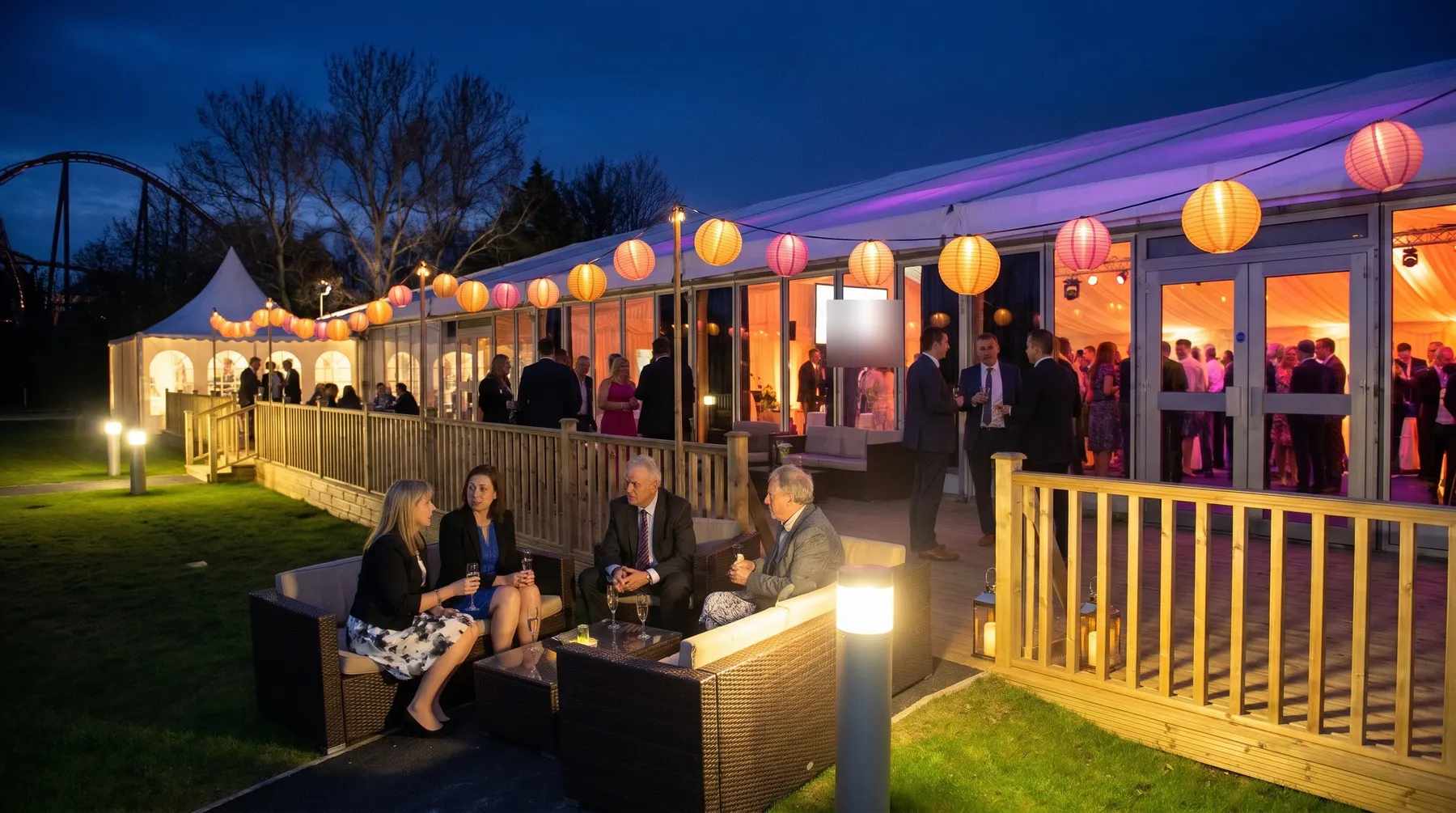
Choose a party month by what you need outside the Hall: it decides how long the Terrace and garden can carry the evening, whether the park is open, and how full the diary is. Long summer evenings suit a party that spills onto the Terrace, days the park is open suit ride time (we confirm this for your date), and the quieter months suit a party that lives indoors, because the Hall has no windows and is the same room in any month. Almost every guide to the party calendar is a summer brochure with a December supplement. It treats the year as though it had two months in it, and that is understandable: June and December are the two months everybody already wants, which makes them the two months with the most written about them and the least room left to move.
The other ten are where the decisions actually live. So here is the whole year at one party venue, the Lakeside Hall in Chertsey, Surrey: what the month changes, what it does not, what the theme park around it can add, and what to ask before you fix a date. The figures for your date are on your written quote, not on this page.
Four things change with the date you choose
Planners tend to treat the season as a single lever. It is four levers, they do not move together, and that is why the month that suits your budget and the month that suits your event are not always the same month.
- The quote — Your date, your numbers and what you choose shape it. If you can move, ask for two dates on the same quote and compare them written down.
- The outdoor part of the day — The Terrace along the Hall's garden side and the private garden below it are outdoors, so the month decides how much of an evening they can carry. The Hall itself is the same room in any weather.
- What the park can add — Park entry, Fastrack and exclusive ride time all need a day the park is open, and we confirm your date before anything is booked.
- What is left in the diary — The constraint most people meet first and plan for last. For the most wanted dates you choose from what remains rather than from what you wanted, which is a different exercise.
The Lakeside Hall has no windows. A wet Wednesday in February and a warm Saturday in July are the same room inside it. That is either the least romantic sentence on this page or the most useful one, because it means the weather can take the garden but it cannot take the event.

The year, season by season
One row per season, and three questions in each. There is no price column: the place for figures is your quote.
| Season | Outside | The park | Planning note |
|---|---|---|---|
| January to March | Plan indoors | Confirmed for your date | Short notice is often enough outside the school holidays |
| April and May | Weather-dependent | Confirmed for your date | Bank holiday weekends are the first to be asked for |
| June to August | The Terrace and garden come into their own | Confirmed for your date | Summer Saturdays compete with weddings |
| September and October | Weather-dependent | Confirmed for your date | Half-term week is the busiest for families |
| November and December | Plan indoors | Confirmed for your date | Christmas party dates are asked for earliest |
The park column is the one to take seriously. Park entry in a day package and ride time by the hour both need a day the park is open. A date we cannot confirm is a date to plan as a venue day, with the park as a bonus if it opens.
Summer is the one season with its own guide: the Terrace, the garden and the wet-weather plan are set out in summer party venues with actual outdoor space.
The dates that are genuinely contested
Availability and price are separate problems, and most people solve the wrong one first. A handful of dates in any venue's year are hard to get. They are predictable, and none of them can be bought with a bigger budget.
- Fridays and Saturdays in December — Many company parties aim at the same few evenings. A Thursday, or a date in January, is the version with room to choose.
- Saturdays in June and July — Weddings and summer parties compete for the same weekends in the stretch of the year when an outdoor deck is most wanted.
- Bank holiday weekends — The Monday is already a holiday, so the Sunday before it is convenient for everyone, which is exactly why it goes.
- The last weekend of the school holidays — A family event that weekend competes with everyone else's, and the park is likely to be at its busiest. Move it a week and both problems ease.
Everything else is the majority of the year. A week of flexibility clears most of those, and it is worth more than anything negotiated off a menu.
The park is the most seasonal thing here
For many people the park is the reason they are reading this, and it is also the part of the offer that depends most on the date. Worth being plain about it before anyone builds a plan around it.
- Park entry: with the day packages — Bronze and Silver day include park entry, on days the park is open. Evening packages include none, so an evening party needs no tickets at all.
- Fastrack: only with park entry — Five levels of queue-jump, available where the group has park entry. On a busy day it changes the shape of the day; on a quiet one you may not need it.
- Exclusive ride time: by the hour — One train for your group, by the hour, on coasters such as Stealth, Colossus, Nemesis Inferno, The Swarm and Hyperia, on days the park is open. When a ride can run is the park's decision, so it is confirmed for your date.
The whole park can also be hired exclusively, for a day or an evening, on a date the park confirms. Ride time is the smaller private part, and it goes on your quote by the hour.

Choosing a seasonal party venue in the right order
The decisions are the same every month. The order they have to be taken in is not. For a contested date the date is the scarce thing, so it goes first and the evening is built around it. For a quiet one nothing is scarce, so the date can wait and the format can lead.
- Contested weeks: hold the date, then design the evening — Take a provisional on a date, then settle the package, then the extras. A group that waits to firm up its numbers before it holds anything risks ending up with neither.
- Quiet months: design the evening, then pick the date — Decide what the night actually is, then choose the Thursday that suits it. That is the better way round, and it is rarely possible in December.
- Outdoors is never the whole plan — Treat the Terrace and the garden as the part of the evening you would be content to lose. If the Hall holds everyone, the forecast decides where people stand, not whether the event works.
- Check the park before the invitations — If the day depends on rides, confirm the park is open for your date before anything is printed.
Two practical things about the winter half of the year. It is dark long before an evening party starts, which makes the arrival part of the night, so tell us how guests are travelling and we set out the route on the quote. And the Terrace is a smaller part of a winter evening, so the Hall carries the whole guest list on its own.
The months nobody asks for
January, February and March are the months people forget, and they are worth a second look. The Hall, the food, the sound and the stage are identical, the Hall has no windows anyway, and the diary has room in it. Whether the price is different is something your quote answers for the date, so ask for one of these alongside the date you first thought of.
Early November is the other underused stretch. A milestone birthday moved out of December into early November can be the same party with far more choice of evening, and not one guest will notice the difference.
The last thing worth saying is that a seasonal plan is only useful before you commit. Once the date is fixed the levers left are the package and the guest list, and both are visible to the people you invited. The date is the one decision that changes what is possible without changing anything your guests see.
Questions people ask
What is the cheapest time of year to hire a party venue?
Ask for two or three dates on one quote and compare them, because your date shapes the quote and the written quote shows each. A quieter month or a weekday is worth including alongside the date you first thought of. The Hall itself is the same room in any month.
Is a summer party more expensive?
Your quote sets out the figures for the date you ask about. What summer changes for certain is the Terrace and the garden, which carry more of the evening in fine weather, and the diary, because summer Saturdays are wanted for weddings as well as parties.
When do venues actually get booked up?
A handful of dates are predictable: December Fridays and Saturdays, Saturdays in June and July, bank holiday weekends and the end of the school holidays. Shifting your date by a week usually clears all of them, and a week of flexibility is worth more than any negotiation over the menu.
Can we use the theme park for a winter event?
Park entry needs a day the park is open, and we confirm it for your date. It comes with the Bronze and Silver day packages, and exclusive ride time is an add-on by the hour, on days the park is open. Evening packages include no park entry.
Which months can we use the Terrace and garden?
Whenever the weather allows. The Terrace, the Hall's outdoor deck, runs along the Hall's garden side with steps down to a private garden, and both are outdoors, so a plan should treat them as the part you would be content to lose. The Lakeside Hall is the room that carries the event in any month.
See if Thrillwater is the right room for your date
Tell us the date you want and the one you could live with, and your planner prices both, itemised, within one working day.