
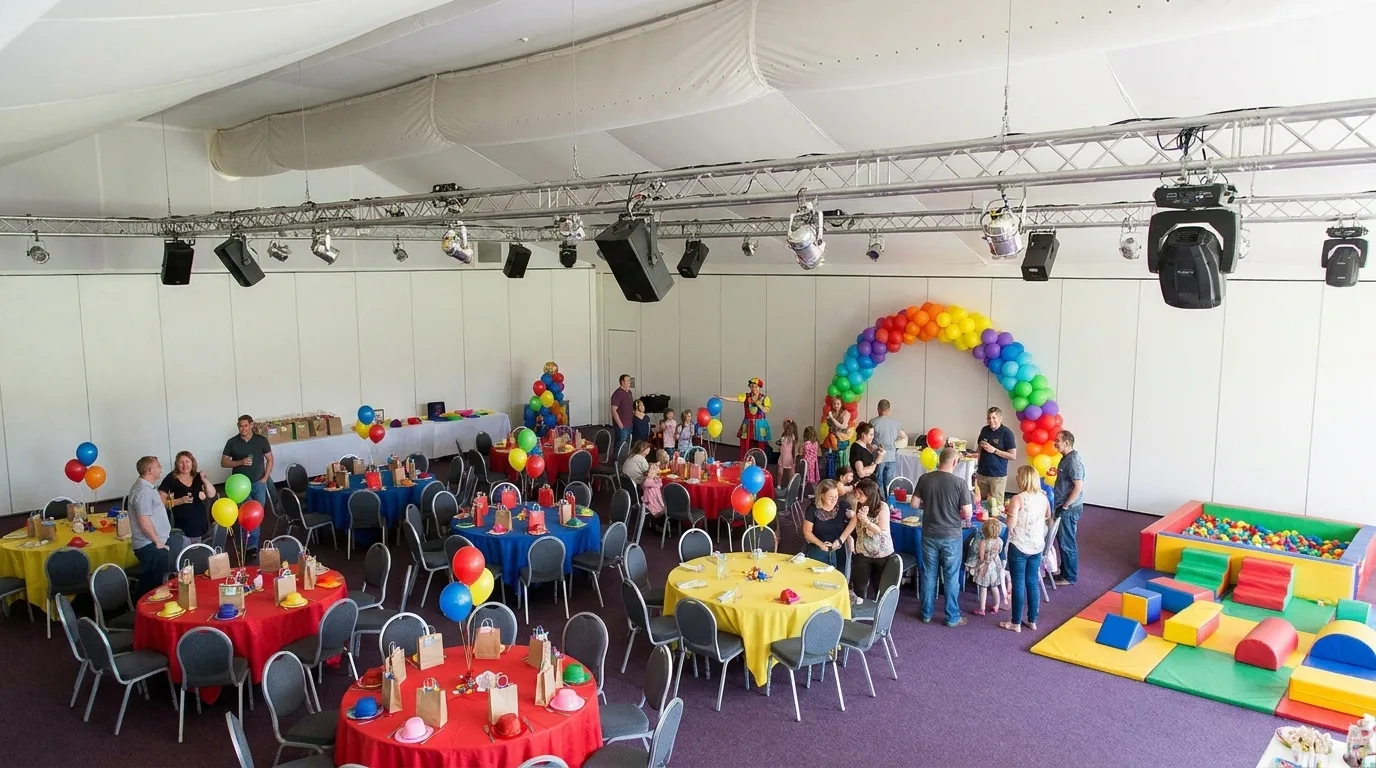
If you are running games for 20 to 40 children in one open room, pick the ones you can explain in one sentence: musical statues, sleeping lions, corners, a relay, a treasure hunt. The trick in a big room is not inventing new games but giving the old ones edges, so the running stays in one place and the quiet games have a corner of their own.
That matters more than it sounds. A living room limits a game by itself; a hall does not, and thirty children let loose on a large floor will find the far wall in about four seconds. This guide sorts the classic games by the space and the supervision they need, gives a running order you can copy, and shows where an entertainer or a scavenger hunt takes over. If you are still choosing a room, our kids' party venue page sets out how a children's party runs here.
Birthday party games sorted by what they need
Every party game falls into one of four groups. Pick one or two from each and the party has a rhythm: a burst of noise, a sit down, a team moment, something to take home.
- Running games: need edges — Corners, stuck in the mud, traffic lights, duck duck goose in a big circle. Mark the play area with a line of chairs or tape so the game has a boundary the children can see.
- Music games: need someone on the pause button — Musical statues, musical bumps, freeze dance, pass the parcel. One adult on the music is the whole job, and a dance floor gives the game a natural stage.
- Sitting games: need a corner and a quiet voice — Sleeping lions, wink murder for older children, a whispering game, guess the sound. These calm the room before food or cake, which is when you need them most.
- Team games: need a few adults to referee — Relays, tug of war with a soft rope, balloon races, a simple quiz with picture rounds. Split by table or colour of sticker, never by picking captains in front of everyone.
Party games that need no equipment are the backbone of any list, and most of the classics need nothing at all: corners, sleeping lions, Simon says, statues and a whispering game run on voices alone. Keep a speaker for the music games and a bag of balloons, and you can run two hours without buying a single prop.
Games by age, from five-year-olds to ten-year-olds
Age changes the game more than the guest list does. A group of five-year-olds needs short rules and everyone to win something; a group of ten-year-olds wants a scoreboard and will argue about it.
| Age | Games that land | Keep each one to |
|---|---|---|
| 4 to 5 | Musical bumps, sleeping lions, parachute games, bubbles, follow the leader | About five minutes |
| 6 to 7 | Musical statues, corners, pass the parcel, simple relays, hide the toy | Five to eight minutes |
| 8 to 9 | Team relays, treasure hunt with clues, charades, balloon races | Ten minutes |
| 10 to 11 | Quiz rounds, wink murder, team challenges with points, a hunt with a timer | Ten to fifteen minutes |
Birthday party games for 5 year olds work best when nobody is out for long. Play musical bumps where the last one down does a silly dance and rejoins, and the tears that end most elimination games never start. For ten-year-olds the reverse is true: give them points, a running total on a board and a prize for the winning team, and they will take it more seriously than you expected.
Games for 10 year olds' birthday parties also need a little dignity. A ten-year-old will refuse pass the parcel and then play it happily if it is called a challenge and every layer holds a forfeit for the whole team.
How many games you need, and in what order
As a planning assumption, a two-hour party holds six to eight games, with food in the middle. That sounds like a lot until you time them: most party games last five to ten minutes once the rules are explained, and the rules take longer than you think.
- Arrival: something they can join late — A colouring table, a balloon game or a simple hunt for stickers hidden around one end of the room. Children arrive across twenty minutes, and nobody should walk into a game already halfway through.
- Early on: the loud games — Musical statues, corners, a relay. Get the energy out while everyone is fresh and before anybody has eaten.
- Before food: a sitting game — Sleeping lions or a whispering game brings the volume down so the children can sit at the table.
- Food and cake — About thirty to forty minutes, with candles at the end of it.
- After food: the team game or the entertainer — A treasure hunt, a quiz or an entertainer's set. Children who have eaten listen better.
- Last ten minutes: a quiet one — Pass the parcel works here, because it ends with a present and a sitting circle just as parents start arriving at the door.
Plan two more games than you think you need, and decide in advance which one you will drop. A game that is not working should end at the first sign of trouble, and a spare in your pocket stops the room drifting.
Where a scavenger hunt fits
A treasure hunt is the one game that grows with the room. In a front room it is five hiding places; in a large hall it can be clues on the stage, under the cloakroom rail and along the outdoor deck, with teams racing each other back to base.
We offer a scavenger hunt as an add-on, and where it runs we confirm for your date, so ask on the quote rather than planning a route of your own. If you would sooner run a home-made hunt, write the clues for the slowest reader in the group, give each team an adult, and set a time limit so nobody is still looking when the pizza arrives.
- Under-sevens — Picture clues and a short route. Every child finds something, and the prize is shared.
- Seven to nine — Written clues in rhyme, four or five stops, teams of four with a grown-up.
- Ten and over — A timed hunt with a final puzzle that needs pieces from every stop, so teams have to finish to win.
When an entertainer takes over the games
At around twenty-five children a parent running every game is doing a full shift, not hosting a party. That is the point where a children's entertainer earns the booking: someone who explains the rules, holds the microphone and keeps thirty children in a circle while you talk to the other parents.
The add-ons catalogue lists what can be booked alongside the party, and the ones that matter for games are the Children's entertainer (magic, games and a lot of noise), Face painting, a Kids' disco, a Craft station for making something to take home, and a Costumed character for a themed visit with no franchises. Each appears on your quote as its own line, and you can mix them: an entertainer for the games, then a craft table during food.
Setting up the room for party games
The Lakeside Hall is one open room with a 30 m by 25 m floor and no windows, set theatre or cabaret style. For a children's party that space is an asset only if you shape it. A few decisions before the day turn it from a hall into a games room.
- Use the stage as base — The removable stage sits on one wall with the screen. It is where the entertainer stands, where prizes are given and where every hunt team runs back to.
- Put the dance floor down for music games — A removable dance floor of 4.5 m by 3.6 m gives musical statues a clear edge. It comes with the Silver evening package and can be added to Bronze evening; with a day package, we confirm it for your date.
- Keep the running and the tables apart — Tables at one end, an open play area at the other. Nobody wants a relay through the sandwiches.
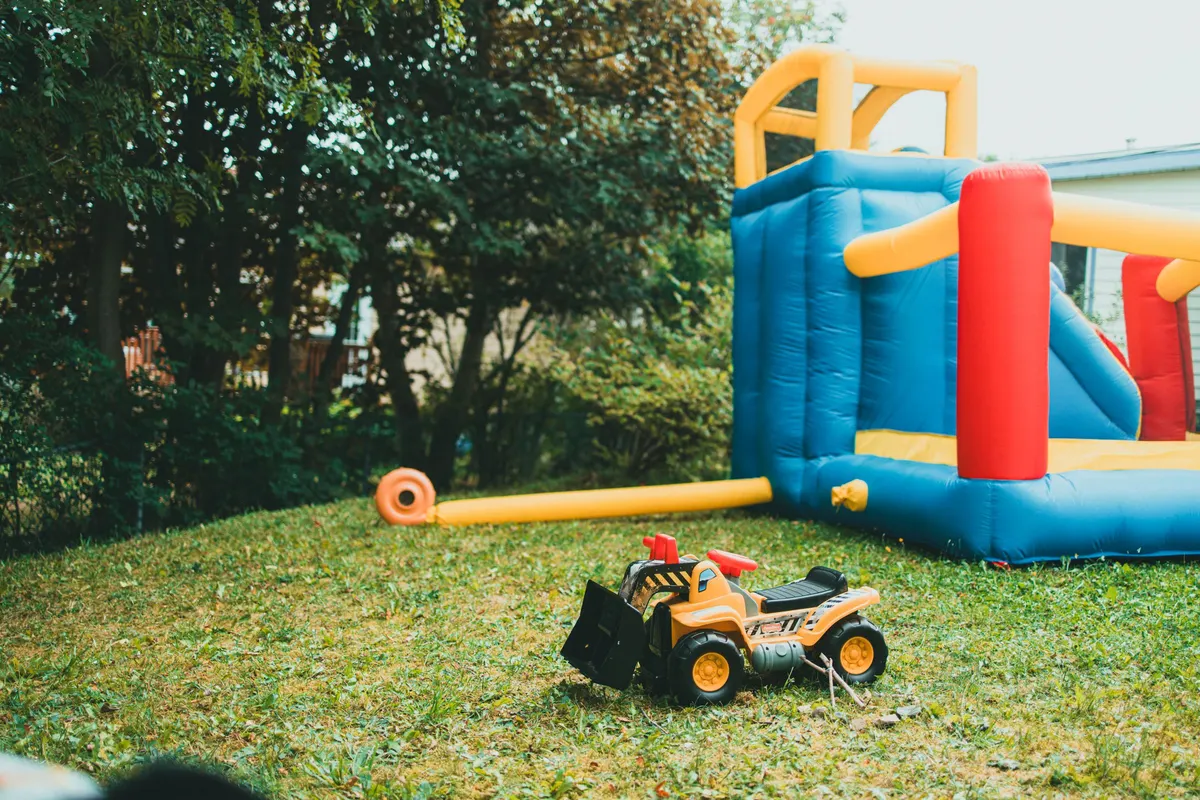
- Take the running games outside on a dry day — The outdoor deck is 31 m by 4.6 m, with steps down to a private garden. On a dry afternoon the garden is where a relay or a game of stuck in the mud belongs.
A room with no windows also means the lighting is yours. Lower it for sleeping lions, raise it for the cake, and the change of light tells thirty children that the game has changed before anyone says a word. Kitchen, accessible toilets and a private cloakroom are part of the building, so the coats and the party bags have somewhere to go.
The rest of the planning, from food to how many adults to expect, is in our kids' party venue page and in our guide to children's party venues.
Questions people ask
What games can you play at a kids' birthday party?
Musical statues, musical bumps, corners, sleeping lions, pass the parcel, relays and a treasure hunt cover every age from four to eleven. Mix a loud game, a sitting game and a team game, and keep each one short. Older children enjoy a quiz or wink murder, younger ones a parachute or bubbles.
What are good party games for 10 year olds?
Ten-year-olds want competition, so give them teams and points: a timed treasure hunt, quiz rounds, wink murder, charades and team relays. Keep a running score on a board and finish with a prize for the winning team. Avoid anything that looks babyish, or rename it as a challenge.
What are good birthday party games for 5 year olds?
Five-year-olds do best with short games where nobody is out for long: musical bumps, sleeping lions, follow the leader, bubbles and a simple sticker hunt. Keep each game to about five minutes, explain the rules in one sentence, and make sure every child goes home with a small prize.
How many games do you need for a kids' party?
Plan six to eight games for a two-hour party, as a planning assumption, with food and cake in the middle. Most games last five to ten minutes once the rules are explained. Keep two spares in reserve, because one game will not work and another will run short.
What party games need no equipment?
Corners, sleeping lions, Simon says, musical statues, wink murder, charades and a whispering game need nothing but voices, and the music games need only a speaker. A bag of balloons adds races and keepy-uppy. You can run a full two-hour party on these without buying a single prop.
A party they will talk about all year
Send the numbers and the games you have in mind, and your planner will tell you how the room can be laid out for them.