
Plan an awards ceremony in this order: a stage the whole room can see, then AV that belongs to the room, then seating that keeps the full list together. Food and timings follow from those three, and at the Lakeside Hall that means a removable 7.3 m by 3.7 m stage, the projector screen on the wall behind it and up to 380 seated for dinner in one open room. Get the first one wrong and the failure is always visible from the back of the room. A winner gets up from table 31, walks to a stage nine inches off the floor, and everybody past the fourth row watches the top of their head. The applause is warm and slightly vague, because half the room is not certain who won.
Almost everything that goes wrong at an awards ceremony is a production problem dressed as a catering one. Three things decide whether an awards ceremony venue works: a stage the back tables can see, AV that belongs to the room rather than arriving in a van at four, and a room that seats the whole list without splitting it. Below about 100 seated, the Lakeside Hall is the wrong shape for a ceremony and we would rather say that now than at a site visit.
How an awards night fails, in order
The failures are sequential rather than random, and each one makes the next more likely. A low stage costs the sight line, a lost sight line costs attention, a room that is not paying attention makes the host work harder, and a host working harder runs long. That is how a ceremony finishes twenty-five minutes late with a kitchen holding 380 puddings.
- The stage is too low — Nine inches is a riser, not a stage. From 300 people back, a winner needs to be high enough to be seen from the waist up, on steps somebody can climb in heels without looking down at their feet.
- The screen is behind the speaker — A screen directly behind a stage is washed out for the front tables and blocked by the speaker for everyone else. Screens flanking the stage is the arrangement that works, and it is a rigging question rather than a hire question.
- The sound was specified for background music — A PA that comfortably handles a DJ will not carry a nervous winner holding the microphone at chest height. Radio mics, a lectern mic and somebody riding the levels live is a different specification entirely.
- One lighting state for two hours — If the room looks identical at the first award and the fourteenth, the audience stops registering that anything has changed. Once there is a rig and a programmer, a state per segment is a matter of programming rather than more kit.
- Nobody stood on the stage before the doors opened — The host, the AV operator and whoever hands over the trophies need ten minutes together in the room. Ask a venue when that can happen. A vague answer means it cannot.
The test that settles a site visit: walk to the furthest table from the stage, sit down in that chair, and ask how high the stage is and where the screens go. A venue that cannot answer both from memory has not run an awards night in that room recently.
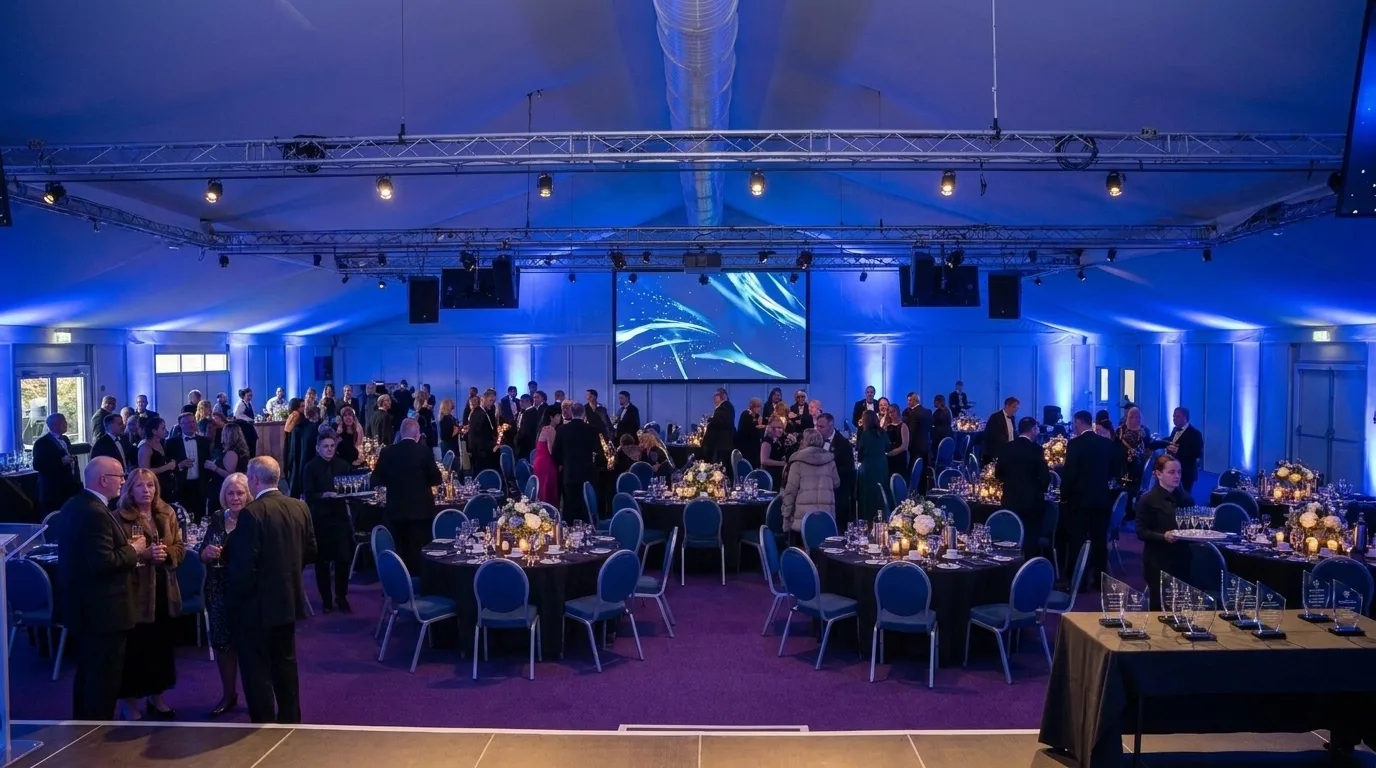
Awards ceremony planning: size the room for the show, not the dinner
Capacity is quoted per layout, and an awards night is the event where that matters most, because you are buying two rooms on one night: a dinner and an auditorium. The Lakeside Hall seats 380 at a banquet and 300 at cabaret, and the gap between those two numbers is the ceremony. Cabaret leaves the stage-facing arc of each round empty so that nobody spends two hours with their back to the presenter. Banquet fills that seat, and roughly a third of the room ends up turning their chair.
So 380 is a true number for a dinner with a short presentation in it, and an optimistic one for a two-hour show. If the ceremony is the point of the evening, size at cabaret and take the smaller headcount; your planner confirms the figure for your layout.
| Seated | Layout that works | What it needs |
|---|---|---|
| 100–120 | Rounds drawn in towards the stage | The stage and screen, with the package's microphone and sound |
| 120–200 | Rounds across most of the hall | The same, with the up-lighters and moving heads lit for the walk-up |
| 200–300 | Cabaret, stage-facing arcs left clear | The package's AV, plus added staging height and an LED screen |
| 300–380 | Full banquet | Gold evening: the production built from the ground up, with planning support |
A ceremony for 150 in a room set for 380 has the same problem as a party in a hall that is too big: applause goes up into the ceiling and the room sounds unimpressed with itself. The Hall is one open room, and for a smaller list the layout does the rest: tables drawn in towards the stage, the dance floor close, and the far end left for the bar and arrival drinks.
Installed AV, or somebody's van
Every venue will tell you it has AV. The question is whether it is rigged into the building, and who is standing at the desk at twenty to eight when the video plays silently and there are ninety seconds to fix it.
Here the Bronze and Silver evening packages come with AV in the room: a projector and the 2.96 m by 2.2 m screen on the stage wall, up-lighters, moving head lights, a microphone and a sound system. For a full ceremony, the Gold evening package builds the AV and production to order, with event planning support. Ask any venue who will be at the desk on the night and whether they have worked in that room before; neither appears on a specification sheet.
The hall has no windows, which is a fair criticism of it for a nine-to-five conference and an advantage for a ceremony. The lighting state you set at four o'clock is the one you still have at nine, and a June awards night looks exactly like a December one.
Production beyond the package is set out line by line rather than folded into one fee. The removable stage and the screen are part of the Hall, and the stage is low: a step up rather than a raised platform, which suits a list of about 150 and needs added height beyond that. Staging sized to your speakers and an LED screen are add-ons, and a follow spot is built to order under Gold evening. Whether a technician stays with your room all night is confirmed on your quote. A ceremony for 150 does not need a follow spot; one for 350 may.
What actually moves the number
The date matters, and awards nights start with an advantage: most industries already hold theirs on a Thursday or a Friday. The quote is for the date, so if yours can move, ask for two dates and compare them before anything else.
- Headcount, through the catering — A seated dinner is the biggest per-head line of the night and it scales exactly with the list. Whether shortlisted nominees bring a guest each is a bigger financial decision than anything on the production schedule.
- Production — Production beyond the package is broadly fixed for a given specification, so it costs proportionally far more at 150 guests than at 350. That is the real argument for keeping a small ceremony simple rather than ambitious.
- The bar — A drinks reception and wine through dinner, or a cash bar and a single glass on arrival. This is where an awards budget is quietly rescued, and it is worth deciding on purpose rather than at the proposal stage.
- The evening after the last award — A dancefloor, or the park. Both cost money, and one of them is the reason the same people accept the invitation again next year.
The gap between the last award and the first song
The most common way a good ceremony goes flat is a twenty-minute hole while the room is reset. The awards finish, the energy is at the highest point it will reach all night, and then 300 people stand in a corridor holding a drink while a crew strikes a lectern and rolls out a dancefloor.
Planning the room for both halves is what removes that. The dance floor is removable, so it is laid in front of the stage before the doors open, with the tables set around it, and the DJ sets up at the side during the main course. Nobody changes rooms and nobody watches a crew strike a lectern.
- Straight into the dance floor — Silver evening includes the dance floor; with Bronze it is an add-on. Plan it from the start and the transition costs the evening no time at all.
- Ride time, on days the park is open — Exclusive ride time by the hour, one train kept for your group. It runs on days the park is open, and we confirm the time for your date.
- A coach home, so nobody drives — Coach hire goes on the same quote as the night. An awards dinner is a drinking event for the winners and a designated-driver event for everyone else, so plan the journey home with the running order.
When this is the wrong room, and what to do instead
For long-service awards at 60 or 80 people, the Lakeside Hall's 30 m by 25 m floor is the wrong purchase. The Garden Marquee is the smaller space, and we confirm its numbers for your layout; below that a private dining room at a good restaurant may beat both. We would rather tell you that now than after you have driven out here.
The other honest limit is geography. We are straight off the M25 at junctions 11 to 13, with car parking included in the Bronze and Silver evening packages, which suits a guest list that drives and a trade association whose members are spread across the south. If your nominees, your press and your sponsors are all within a mile of each other in central London, a Surrey venue costs you attendance, and a coach only half solves it. If they are not, ask about a date through our awards ceremony page.
Questions people ask
How many people can you seat for an awards ceremony?
380 at a banquet and 300 at cabaret, and for a ceremony the cabaret figure is the honest one; your planner confirms it for your layout. It leaves the stage-facing arc of each round empty, so nobody watches an hour of speeches over their own shoulder. Size the booking on the layout the ceremony needs, then check the dinner still fits.
How high does the stage need to be?
It depends on the back row rather than the headcount. Up to around 150 a low stage is fine, because the furthest table is still close; the Hall's own removable stage is a step up. Past 250 a winner needs real height or the back third watches the top of a head, so add staging sized to your speakers, and remember the steps matter as much as the deck.
Is the AV included or charged separately?
Some of it is included: the Bronze and Silver evening packages come with a projector, the screen, up-lighters, moving head lights, a microphone and a sound system. Anything beyond that, such as added staging, an LED screen or a follow spot, is an add-on or built to order under Gold evening, and whether a technician stays on the desk all night is confirmed on your quote, so you can cut what a smaller ceremony does not need.
What night of the week should an awards ceremony be held on?
Thursday or Friday is what most industries already do, and it works. The quote is for the date, so if yours can move, give us two dates and compare them: it is the one decision that can change the total without any guest noticing a difference.
What happens after the awards finish?
The dance floor, laid in front of the stage from the start so there is no reset gap: it comes with Silver evening and is an add-on with Bronze. Exclusive ride time can be added by the hour on days the park is open, for a group that wants one more thing to remember, and we confirm the time for your date.
Give your team a day somewhere different
Tell us the headcount, the date and how long the ceremony runs, and your planner comes back within one working day with the room, the catering and every production line itemised.